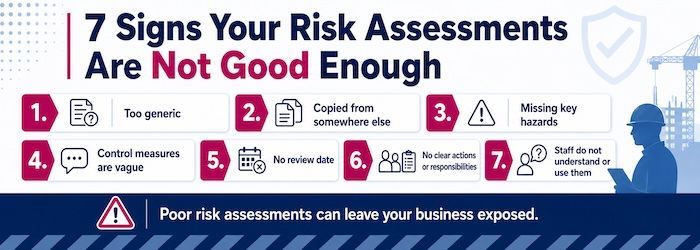
7 Signs Your Risk Assessments Are Not Good Enough
Risk assessments are one of the most important parts of managing health and safety in any business but having a risk assessment does not automatically mean it's good enough.
Many businesses have documents in place that look fine at first glance, but when you read them properly, they are too generic, too vague or simply do not reflect the work being carried out.
Here are seven signs your risk assessments may need reviewing.
1. They could apply to any business
A risk assessment should be specific to your workplace and your activities.
If it looks like it could have been copied and pasted from somewhere, that is usually a warning sign. Generic risk assessments often mention basic hazards but fail to include the detail that actually matters, such as:
- The specific equipment your staff use.
- The layout of your workplace.
- The people who may be affected.
- The real way the task is carried out.
- The actual controls you rely on to keep people safe.
A risk assessment for a warehouse, workshop, office, construction site or manufacturing area should not all read the same.
2. The control measures are too vague
Control measures should be clear enough for people to understand what they need to do in order to keep safe.
Phrases such as “take care”, “use PPE”, “follow safe working procedures” or “staff to be trained” are often not enough on their own.
A better risk assessment should explain what control measures are required. For example:
- What specific PPE is needed?
- What specific training is required?
- What checks must be carried out?
- What equipment should be used?
- Who is responsible for supervision?
- What must staff do before starting work?
If the control measures are vague, they are difficult to communicate, monitor and enforce.
3. Staff do not know what is in them
A risk assessment is not much use if it stays in a folder and nobody knows what it says. Staff should understand the main risks involved in their work and the control measures they are expected to follow.
This does not always mean handing everyone a huge document to read. It may be better to communicate key points through training, toolbox talks, briefings or supervision. If staff are unaware of the risk assessment, it is unlikely to be working effectively.
4. They have not been reviewed for years
Risk assessments should be reviewed when things change.
This could include:
- New equipment.
- New substances.
- New processes.
- Workplace layout changes.
- New staff or vulnerable workers.
- Accidents or near misses.
- Changes in guidance or working methods.
Even if nothing obvious has changed, risk assessments should still be checked periodically to make sure they remain suitable. Many companies also have a policy to review them every 12 months.
If the document date is several years old, it is worth taking another look.
5. They focus only on paperwork, not real work
One of the biggest problems with poor risk assessments is that they describe an ideal version of the job, not the real version. For example, the document may say a task is always done by two people, but in reality staff often do it alone.
Or it may say equipment is checked before use, but nobody can show that this actually happens.
A useful risk assessment should reflect what happens in practice. If there is a gap between the paperwork and the workplace, that gap needs closing.
6. They miss obvious groups of people
Risk assessments should consider everyone who could be affected.
This may include:
- Employees.
- Contractors.
- Visitors.
- Customers.
- Members of the public.
- Young workers.
- New or inexperienced staff.
- Pregnant workers.
- People with health conditions or disabilities.
This is especially important in workplaces where other people may be nearby, such as occupied buildings, shared premises, public areas or client sites. If your risk assessments only mention employees, they may be missing important risks to others.
7. Managers cannot explain whether they are suitable
Managers and supervisors do not need to be health and safety experts, but they should understand the risks in their area. A really useful moment during IOSH Managing Safely training is when managers start looking at risk assessments more critically. They often begin to spot whether the documents are actually useful or just there to tick a box.
That is one of the reasons IOSH Managing Safely in Hull can be so valuable for local businesses. It helps managers understand what good risk management should look like in practice.
What should you do if your risk assessments are not good enough?
The first step is to review them honestly.
Ask:
- Do they accurately reflect the work?
- Are they specific to the workplace or generic?
- Are the controls clear and easy to understand?
- Have staff been told about them?
- Are managers checking that controls are followed?
- Have they been reviewed recently, or are they in a file gathering dust?
If the answer is no, it may be time to update them.
Jewel Safety provides practical health and safety consultancy and risk assessment support for businesses in Hull, East Yorkshire and the surrounding area.
Good risk assessments should help your business manage risk properly. They should not just be paperwork for the shelf.
For help reviewing your risk assessments, contact Jewel Safety